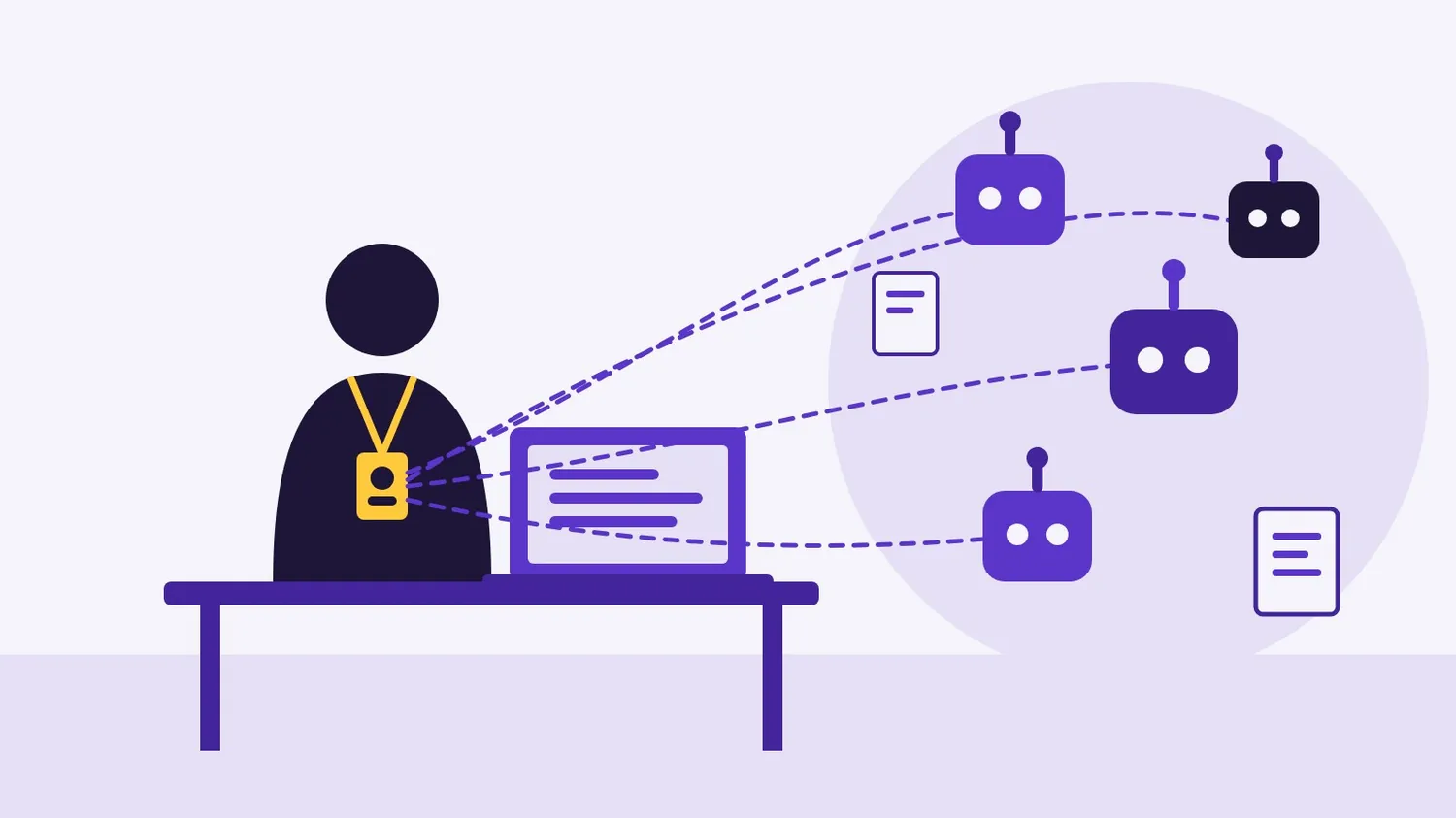
Last week’s story was the oversight tax: the unpaid hours people spend checking what AI produces. This week the data moved one step further. AI is no longer just drafting things for you to review. It is increasingly doing things, through agents, and a lot of those agents are doing them with your access.
That changes the question from “how much time does AI save?” to “whose name is on what the AI did?” If an agent you set up in Zapier, Atlassian, or a chat assistant sends the wrong file to a client or reads a folder it should not, the audit trail does not say “the agent.” It says you.
Here is what landed between November 16 and 17, 2026, and what to do about it.
Nudge Security: agents run on employee identities
On November 17, Nudge Security published new research on AI adoption and agents, based on what it observes across customer organizations. The agent numbers (as of October 2026) are the part worth reading twice:
- Among organizations using AI agents, half run seven or more, and more than 4 in 10 run more than 10
- More than half run agents across two or more platforms, including Atlassian, Claude, Cursor, OpenAI, and Zapier
- Agents built inside business platforms often act through the employee who created them, using that person’s access to company data
That last line is the one that matters for ordinary workers. When you build a small automation that summarizes tickets, files invoices, or answers client emails, it usually inherits your permissions. It can see what you can see and send what you can send. Nudge’s CTO, Jaime Blasco, said plainly: “We expect this to get harder, not easier.”
The same report shows how crowded the toolbox has become. Half of organizations have had 27 or more AI tools show up, twelve tools each appear in more than half of organizations (up from five in January), and 18% of observed prompts include pasted content or an uploaded file. Every one of those pastes is a small decision about company data, made by a person, usually without a policy in front of them.
Pipefy: a third of companies have no rules at all
On November 16, Pipefy released a survey headlined More than 34% of U.S. Companies Report that Employees Use AI Tools with No Governance Policy. Put that next to Nudge’s agent counts and the picture is simple: the agents are already running, and in roughly one company in three there is no written rule about what they may touch.
When there is no policy, the default policy is “whoever set it up is responsible.” That is fine until something goes wrong.
Gallup: managers are mostly not in the loop
Gallup added two pieces this month. On November 16, it published how AI is changing the way employees spend time, from a survey of 2,648 U.S. employees fielded in August:
- 32% of U.S. employees now use AI a few times a week or more, and 16% use it daily
- Among remote-capable workers, 49% use AI frequently and 26% daily
- 88% of frequent users say AI has changed how they spend their time, mostly less time gathering information (52%) and writing (47%)
- But 82% say time with customers is unchanged and 83% say meeting time is unchanged
- 36% of frequent users say AI has raised their daily output expectations, and 33% feel pressure to use it
Gallup’s AI and productivity page, updated November 10, adds the manager angle. Only 36% of employees in AI-integrating organizations strongly agree that their manager actively supports their team’s AI use. Those who do are 9.3 times as likely to say AI has transformed how work gets done.
Read together: people are using AI more, expectations are rising, and most of the guidance is missing. That is exactly the gap where a quietly built agent with broad access lives.
G-P: agents as coworkers, with performance reviews
On November 17, G-P (Globalization Partners) published its 2027 work predictions, based on a survey of 4,000 employees and 3,100 executives. G-P sells global employment services, so read it as a vendor survey, but two numbers are striking:
- 68% of workers expect the number of AI agents on their immediate teams to surge within three years
- 67% of executives say they already run formal performance reviews for AI agents, as they would for human direct reports
G-P’s chief product officer, GK Konduri, put the standard this way: “The measure of success isn’t just task completion, but accuracy, context and judgment included in the response.”
If agents are getting performance reviews, someone is writing them. In practice that someone is the person who deployed the agent. Your agent’s error rate is quietly becoming part of your own review.
The product launches point the same way
The same day, vendors kept shipping. Napster launched an Enterprise plan that gives each employee a crew of coordinating agents connected to Microsoft 365, Google Workspace, Slack, Salesforce, and HubSpot. OfficeSpace expanded its AI Canvas with one agent for booking, workplace operations, and portfolio insights, which IT teams can also plug into Claude, ChatGPT, or Copilot.
The pitch in both is “every employee gets agents.” The fine print is that every employee also gets the accountability for what those agents do with their connected accounts. We saw the first wave of this in always-on workplace agents back in September. Two months later, it is not a preview anymore.
What to do this week
You do not need to stop building automations. You need to own them on purpose.
Inventory your agents. List every automation, custom GPT, Zapier zap, Atlassian rule, or assistant integration you have set up. Most people undercount. If Nudge’s median company runs seven or more agents, some of yours are probably on that list.
Check what they can reach. For each one, open the OAuth grant or connected-app settings and see what it can read and send. Nudge’s own advice is to review those grants. If an agent that only needs one shared folder has access to your whole drive, narrow it.
Give each agent a written job description. Two lines: what it does, and what it must never do (send externally, delete, approve payments). This is the same discipline employers want when they ask for people who build with AI, not just prompt it.
Tell your manager before something breaks. With only 36% of employees feeling actively supported, odds are your manager does not know what you have automated. A short note (“here are the three agents I run, here is what they touch”) turns a future incident from “you did this alone” into “we agreed on this.”
Freelancers: put agents in the contract. If you run agents against a client’s Slack, CRM, or inbox, say so in writing, list the access you need, and state who revokes it when the engagement ends. It is the same disclosure logic from the AI governance trust gap, applied to tools that act, not just tools that write. Philippine-based freelancers working for U.S. or EU clients should assume those clients will start asking.
Turn agents off when a project ends. Orphaned automations with live access are the easiest security finding in any audit. Make “revoke agent access” a standard step in your offboarding checklist.
The bottom line
This week’s numbers do not say agents are bad. They say agents are already everywhere, they often run under a real person’s identity, and in a third of companies nobody has written down the rules.
Until your employer catches up, the safest assumption is simple: if it runs on your login, it is your work. Treat your agents like junior teammates you are responsible for. Know what they do, limit what they can reach, and make sure someone above you knows they exist.